

 44Likes
 LinkBack URL
 About LinkBacks
Our club is using alot of military rifles in their original configuration and sights etc, many still shooting the old CAC stuff with cordite which im now trying to avoid.Originally Posted by Jhon

Im not sure what standard people are using for competitive sports, but I do know that many seek the standard 174 grain flat base bullets that are no longer produced.
It appears that a load of 46 grains or so is getting near the top end for 2440fps, so not exactly modest, but will be interesting to see how many reloads I get.
yes I get the feeling that the chambers on most 303 rifles are fairly sloppy.
My main concern is if i get them stretch too much and cause problems, do you typically have to shorten 303 cases much because of this?
Looks like 56.4mm is the maximum length, but my cases are closer to 56.5mm, if i keep the same cases for each rifle, will they stay the same length as the chamber?
Welcome guest, is this your first visit? Create Account now to join.

Welcome to the NZ Hunting and Shooting Forums.
Search Forums


User Tag List
+ Reply to Thread
Results 46 to 55 of 55
Thread: 303 MK7 load data?
-
26-07-2025, 03:15 PM #46Member


- Join Date
- Sep 2022
- Location
- Tauranga
- Posts
- 598
-
-
26-07-2025, 06:51 PM #47Member
- Join Date
- Jul 2024
- Location
- Albany, NZ
- Posts
- 87
First you need to understand what's going on with the .303 that is different to a rimless cartridge.
The .303 headspaces on the rim. The shoulder does not contact the chamber prior to firing. When fired, the brass expands into the chamber and the shoulder is blown forward to fill the chamber.
Compare a new, unfired case to a fired case and you will see that the shoulder has moved forward. When this happens, the case stretches, particularly about 3/8" forward of the rim.
If you full length size the case, it will stretch again when fired.
If you only neck size without touching the shoulder, then the case will head space on the shoulder for future firings. This reduces stretch and helps with accuracy. Over time, the brass does still flow forward, so you will have to trim the length, but not as much as if you are full length sizing.
If you full length size, you can expect case head separation in as few as 3 or 4 firings, whereas neck sizing can give 10 or more reloads.
In my opinion, the Lee collet die is an absolute must for the .303. I use around 46.5gr AR2209 with a 174gr projectile.Old_School likes this.
-
26-07-2025, 07:18 PM #48Member
- Join Date
- Dec 2019
- Location
- Okawa Hawkes Bay
- Posts
- 3,397
Greetings, Originally Posted by Old_School
After a break of some 40 years I timidly entered the .303 world again around 10 years back for an iron sight comp. I had been loading light loads for 4P shooting mostly at 100 yards in my .308 using 40 and later 38 grains of AR2206H with 150 grain projectiles. The .303 rifles bore was good but not pristine and an arbitrarily selected load of 40 grains of the older AR2209 with the 174 grain Hornady round nose. Cases were sized with a Lee loader. Previously fired cases from a different rifle chambered and were used. I found very little stretching that I could detect and even cases that chambered snug chambered freely after firing. Velocity was around 1,950 fps and accuracy good. So in answer to your question you will need to trim cases after their first firing but if you keep the same cases for each rifle and neck size preferably with a Lee loader or Lee collet die and keep pressures low little if any trimming should be needed. I would steer clear of conventional neck sizing dies as some makes tend to oversize the brass which can lead to case stretching. When the neck is sized down it becomes longer. It shortens when it is expanded but not as much. this happens with the two neck dies as well but not to the same extent.
GPM.Old_School likes this.
-
26-07-2025, 09:05 PM #49Member
- Join Date
- Sep 2022
- Location
- Tauranga
- Posts
- 598
Yes, thats what Ive noticed with my fired cases. From what I gather this expansion is experienced in all firearms to some degree, but with the 303 is notably greater. Originally Posted by Crusty
Even though the 303 headspaces on the rim, it would appear that there is still quite a bit of space between the neck and chamber wall compared to other calibers.
Something else Ive learned, is what I and others considered to be headspace is actually head clearance, seems many people get these two mixed up, but i see that too much head clearance on these rifles can cause extra case stretching too.
Ive seen some say the loose space was intentional to allow dirty rounds covered with mud to still chamber in a battlefield situation, others say its just a result of them being mass produced with low tolerances, I also read that the bolt can move back a bit when fired which also allows the case to expand lengthwise.
Im not 100% sure what of any of this is true, there seems to be a ton of opinions on this on the internet, all I do know is its pretty evident that there is room for expansion in the chamber on these rifles.
I definitely want to grab one of these lee collet dies for sure.
Thanks, I will keep that in mind. Originally Posted by grandpamac
I was in at Reloaders supplies yesterday to get my powder but they had no Lee collet dies in stock, but I should be able to get one in.
Meanwhile, I still have enough cases to load that have not been fired yet, will need to measure all the other cases ive got to see how many need trimming.
-
27-07-2025, 11:14 PM #50Member
- Join Date
- Sep 2022
- Location
- Tauranga
- Posts
- 598
Well here are my first reloads.
All fired successfully with modest recoil.
I aimed at the centre of a piece of plywood and got 150mm average groupings with iron sights at 50m away. Need to test groupings on my scoped rifle next time.
Anyway, no real issues to speak of.
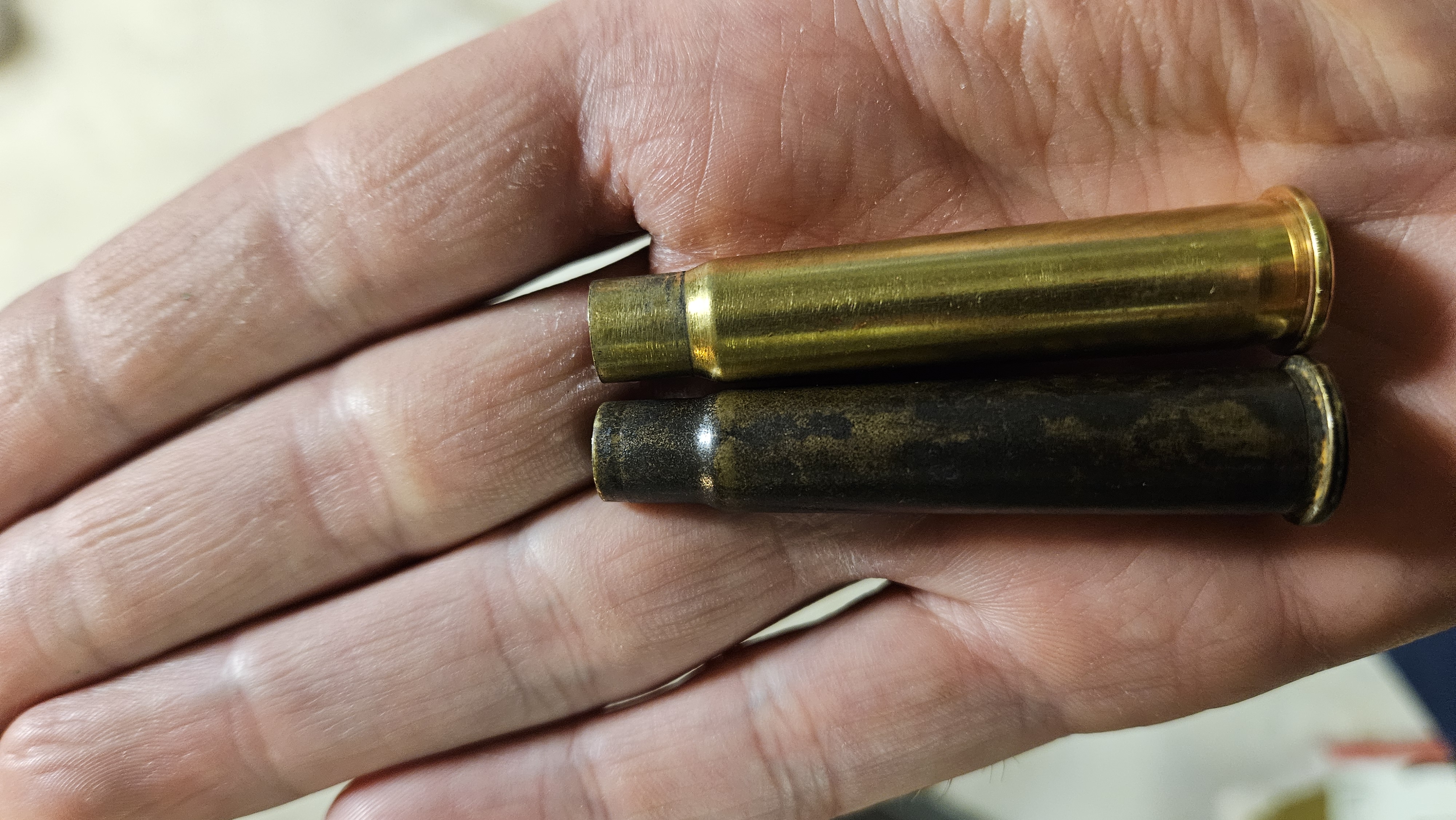
Case appears to possibly be more stretched, neck looks slightly shorter.
Im not sure if this is just a more sloppy chamber in this rifle yet, its the first time I've fired this.
See the photo alongside a factory HXP load (tarnished case) both were individually fired in separate rifles.


-
04-08-2025, 10:49 PM #51Member
- Join Date
- Sep 2022
- Location
- Tauranga
- Posts
- 598
Well here is an update on the chronograph readouts from various loads along with readings from HXP that ive got.
I fired 3 HXP rounds as a ballpark figure and their velocity is pretty shit, from what I understand, they are supposed to have a velocity of 2400fps, this could be due to age however and their poor storage conditions.
HXP velocity as follows x3 rounds:
2149, 2134, 2132fps
AR2209 loads as follows:
45.5gr 2321fps
46gr x2 2340fps and 2364fps
46.5gr 2368fps
47gr x2 2395fps and 2379fps
47.5gr 2455fps
Looks like somewhere close to 47.5 grains will give the desired velocity, however I would need to try several more loads to work out an average and test in different rifles.
I hope this is help to anyone else wanting to do MK7 loads with the original flat bottom projectiles.
-
04-08-2025, 10:58 PM #52Member
- Join Date
- Feb 2017
- Location
- Jafa land
- Posts
- 5,744
good stuff. i still have some old mk7 to shoot off but i will keep this in mind when i reload 303! Originally Posted by Old_School
Old_School likes this.
-
04-08-2025, 11:35 PM #53Member
- Join Date
- Sep 2022
- Location
- Tauranga
- Posts
- 598
Will be interesting to compare how you go if you can get a reading. Originally Posted by Russian 22.
Im still not sure if i need to chase up the whole thing on barrel harmonics or not, but Im happy if I can get the 2400fps target.
46.4grains should do it i think.
-
05-08-2025, 03:43 PM #54Member
- Join Date
- Dec 2019
- Location
- Okawa Hawkes Bay
- Posts
- 3,397
Greetings @Old_School,
A lot of .303 barrels are pretty worn and produce velocities well short of those less used. Pressure barrels are made to tight tolerances so there can be a big gap between current published velocity and what the handloader will achieve. A few years back I subscribed to Loaddata.com and found some data that Brian Pearce had shot in a No4 Mk1 with the standard barrel. His data was for the Hornady 174 grain RN or FMJ BT and pressures were kept low with respect to the age of the rifles likely to be used. He did not load AR2209/H4350 but did load IMR4350 which is close to AR2209 these days. He gave a list of increasing loads and velocities quitting at 44.6 grains of IMR4350 for 2,227fps. Extrapolating from that 45.5 grains of IMR4350 should produce around 2,270 fps and 46.5 grains 2,330 fps. Your rifle is producing a little more velocity for whatever reason. My 40 grain load with the 175 grain RN came in a little slower as expected, 1,945 fps calculated v 1,930 fps chronographed.
To be clear I don't post load data from Loaddata.com on the internet but do use limited quotes in my posts where it helps understanding.
Regards Grandpamac.Old_School likes this.
-
05-08-2025, 04:57 PM #55Member
- Join Date
- Sep 2022
- Location
- Tauranga
- Posts
- 598
Yes I wondered if that could be the case here, the rifle i did these tests on appears to have a good barrel, but I have not slugged this bore or put a bore gauge in it yet, but when i place a round in the muzzle it does not drop down far. Originally Posted by grandpamac
I do have another rifle which I do know has a very tight bore when measured, so would have been good to make a comparison in that rifle too.
I also believe that even from new, tolerances in the barrels was poor with some being looser than others, I believe this was a major issue with some no4 rifles having very sloppy barrels from what ive been reading.
If i find that the velocity is higher in my other rifle, I will tweak down the load, its probably a good idea to average it over several rifles to work out how it performs.
The fella with the chronograph said that he measured some old cordite loads in his rifle and they all were spot on around the 2400fps mark that they are supposed to be, but I dont know the condition of his barrel.


 Reply With Quote
Similar Threads
-
Old adi load data
By csmiffy in forum Reloading and BallisticsReplies: 15Last Post: 13-05-2025, 01:19 PM -
30 CAL D46 Load Data
By dnsn in forum Reloading and BallisticsReplies: 0Last Post: 16-02-2024, 05:56 PM -
BSA Load data
By Ryan_Songhurst in forum Reloading and BallisticsReplies: 4Last Post: 26-12-2022, 09:15 AM -
.308 load data???
By SiB in forum Reloading and BallisticsReplies: 7Last Post: 06-11-2013, 12:18 PM -
338 load Data
By PerazziSC3 in forum Reloading and BallisticsReplies: 6Last Post: 30-10-2013, 11:52 PM
Tags for this Thread

 Posting Permissions
- You may not post new threads
- You may not post replies
- You may not post attachments
- You may not edit your posts
Welcome to NZ Hunting and Shooting Forums! We see you're new here, or arn't logged in. Create an account, and Login for full access including our FREE BUY and SELL section Register NOW!!
All times are GMT +13. The time now is 05:24 AM.

Bookmarks