

 75Likes
 LinkBack URL
 About LinkBacks
Good to see some interest in the discussion and hearing some different points raised. I'm keen to hear others opinions.
I think my primary interest in this instance, is in how the information is communicated, or utility of the model, more so than the accuracy (precision!) of the model (which is obviously important).
I think that new players in the reloading space especially, are required to wade through a lot of information that often competes and conflicts at times. Maybe there is a better way to communicate the important stuff?
Personally, I spent a lot of time enamored with the OCW method of load development; however after learning more, I see that the variables I was manipulating were unlikely to be having the effect I thought they were. Not to say I didn't develop a good load, but that I probably wasted components unnecessarily for an outcome that I could have likely achieved by picking a random charge weight (RCW method?).
If I recall correctly, one of the famous Greek philosophers described wisdom as being able to see through the bullshit, to the true patterns of reality. Similarly with reloading, I think we want to be identifying the 'true' patterns, and not be fooled by the three-shot groups so to speak.
All this to say, like more learned folk have already suggested - a good platform, combined with a powder and projectile combo that plays nice, some decent fundamentals, and you're likely 90% (or more) of the way sorted.
Welcome guest, is this your first visit? Create Account now to join.

Welcome to the NZ Hunting and Shooting Forums.
Search Forums


User Tag List
+ Reply to Thread
Results 16 to 30 of 70
Thread: Variables affecting precision
-
12-07-2025, 03:16 PM #16Member

- Join Date
- Dec 2024
- Location
- Manawatu
- Posts
- 298
Zedrex likes this.
-
-
12-07-2025, 03:24 PM #17Member
- Join Date
- Dec 2024
- Location
- Manawatu
- Posts
- 298
Yes good points. I probably could have labeled it better. I was thinking more about reloading specifically, i.e. those things that we tend to play with, rather than all factors affecting precision. Originally Posted by zeropak

I used the circle (shooter related factors) to lump a lot of stuff together, which I guess could include environmentals. I wanted to try show how any of the variables on the pyramid will be constrained by this. I guess if i was going to make a flow chart, I might say something like - step 1 - "establish baseline accuracy of platform and shooter", before progressing to playing with any reloading stuff.
-
12-07-2025, 03:38 PM #18Member

- Join Date
- Jun 2020
- Location
- Victoria AU
- Posts
- 1,408
Perhaps you need two pyramid s.
1 for rifle, 1 for shooter and environmentalHunt safe, look after the bush & plug more pests. The greatest invention in the history of man is beer.
https://youtu.be/2v3QrUvYj-Y
A bit more bang is better.
-
12-07-2025, 03:39 PM #19Member
- Join Date
- Sep 2013
- Location
- Wairarapa
- Posts
- 1,730
Originally Posted by earplay
I think you’re definitely onto a few things here.
Firstly being able to create a simple visual that ranks influential factors in order of influence is gold.
Secondly, and I think if the other thread proves anything, it is that in reloading, it is easy to confuse the noise for the signal and the signal for the noise.
Where your diagram gets difficult, and this is in no way trying to discredit the idea, because I personally do like it, but the difficult part is that accuracy is actually three main triangles in parallel.
One is the rifle
One is the shooter
One is the load
Some aspects of each are independent, others are interdependent, and it is the sum of all, that decides the tightness of the group.
To complicate it further, cost to isolate/manipulate a given variable, isn’t necessarily proportional to the amount of change.
Knowing what is the low hanging fruit helps, and I think in many ways, your diagram seeks to show it.
If the diagram could account for and accommodate all of this, it would really be useful. The hard part is getting it there.earplay likes this.
-
12-07-2025, 03:42 PM #20Member
- Join Date
- Dec 2024
- Location
- Manawatu
- Posts
- 298
All good points. Originally Posted by 19Badger
For small seating depth changes etc, I would imagine that the 'resolution' of the system will dictate the extent to which differences are able to be resolved so to speak. i.e. it may be an irrelevant variable for the casual hunter with his stock rifle, while important for the competitive bench rest shooter with a highly tuned setup.
It reminds me of one of my other hobbies, hifi audio, where people will frequently argue that you need to have a certain level of fidelity to 'hear the difference' of various equipment (e.g. amps, converters). Lots of voodoo in that hobby too though
19Badger likes this.
-
12-07-2025, 03:45 PM #21Member
- Join Date
- May 2023
- Location
- New Zealand
- Posts
- 285
Any outcome is dictated by the variables and what you are trying to achieve.
Zeropak made an excellent point, the rifle is separate to the ammunition, you can alter the rifle, ie trigger, bedding, barrel, stock etc change any of those and you need to start the ammunition tuning again.
If the rifle has a fault, ie bedding, fire control, barrel, etc it doesn't matter what you do to the ammunition the accuracy will never be what it could be
To give an example of A "factory" rifle accuracy a Sako 223 with tuned ammunition fired 5 x 5 shot groups at 100yds for an aggregate of 0.600" (15.24mm) for two hundred with a further 5 x 5shot groups the aggregate was 0.4792" (12.172mm) giving a grand agg of 0.5396" (13.706mm)
Of course this is specific to this rifle, but those groups were shot off a front and rear rest by the owner of the rifle.
Will all rifles achieve this?
If you took that ammo and used it in another .223 would the outcome be the same?
If another person used this rifle, the same equipment and the same ammo would the result be the same, better or worse?
From what I understand that rifle has been sold and another rifle purchased, somebody owns a fantastic factory rifle and I'm sure the loading data would have been passed along also.earplay likes this.
-
12-07-2025, 04:38 PM #22Member
- Join Date
- Dec 2024
- Location
- Manawatu
- Posts
- 298
Appreciate the feedback. Originally Posted by longshot
I probably should be more specific by saying something like "reloading variables affecting precision", to avoid scope creep beyond my intended purpose - i.e. helping newer reloaders. (Obviously there are lots of other factors - something like reading the wind is a useful skill to develop if getting into longer range shooting, however not that relevant for maximising the precision of a certain load and not where you need to start necessarily). What I tend to see is people starting in the middle of the pyramid (e.g. fiddling with 0.2gn powder variations), which seems a less helpful place to begin if your goal is maximising precision.
I think the details of this stuff has all been pretty well hashed out on this forum by gimp and others already, so I don't have any real expertise to add to that conversation - I'm just wondering if it could be communicated in a more succinct way.
I think any good visual model needs to strike a balance between generality and specificity - and probably leaning more towards the former. I probably need to make it more simple, rather than more complicated. Maybe a flow chart might be more useful.
-
12-07-2025, 04:57 PM #23Member
- Join Date
- Sep 2013
- Location
- Wairarapa
- Posts
- 1,730
Yeah that makes sense. So if you confine the triangle to load data factors only, it does get much easier. Originally Posted by earplay
-
12-07-2025, 08:18 PM #24Member
- Join Date
- Dec 2024
- Location
- Manawatu
- Posts
- 298
Ok so I had a play with this idea a bit further. I think I was making things confusing for myself (and others) by trying to be too comprehensive, as in covering all the factors that contribute to precision.
If I go back to my original idea, it was to try create a visual model that might help communicate some of the important factors in load development, especially for new reloaders. While not specific to the load development process, I felt it was important to have the shooter as foundational, as this will in theory set a reference for any load that is developed (assuming precision is part of your goal). I removed a few bits and added some, to try and make it a bit more instructive while hopefully not overly complicated. It's not perfect by any means, but I would be interested to hear if it makes basic sense.
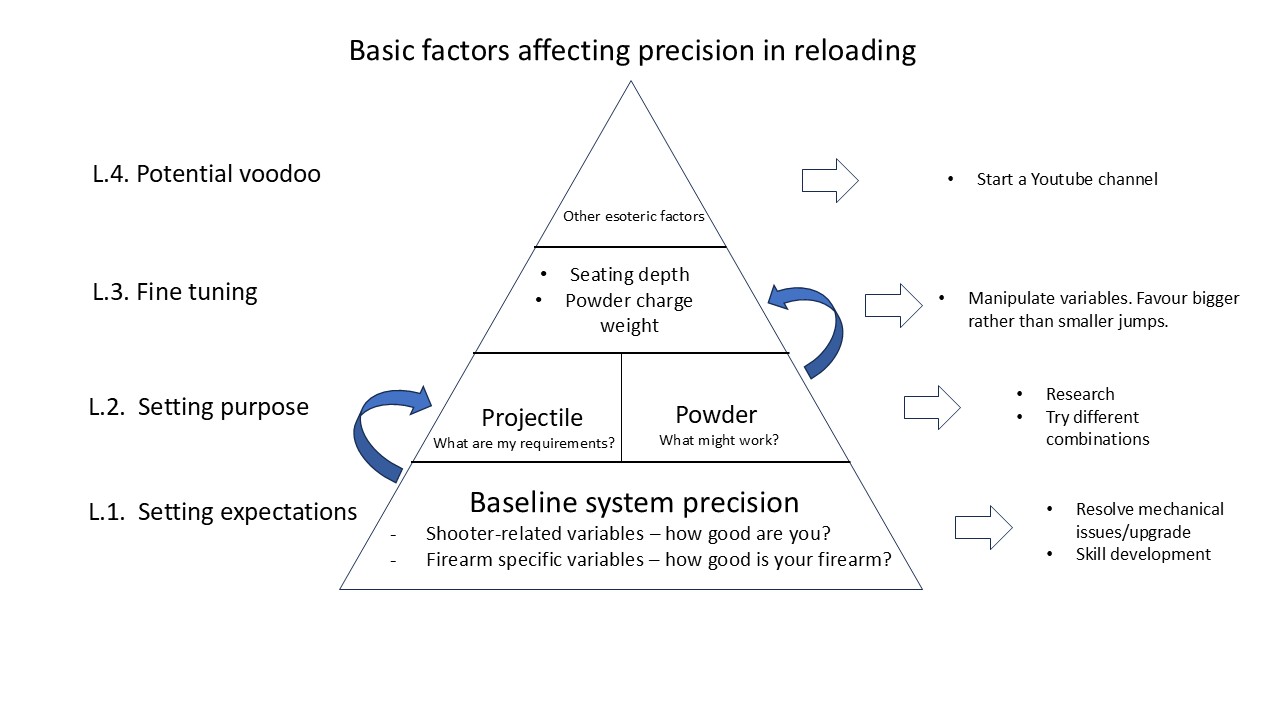 whanahuia likes this.
-
12-07-2025, 11:49 PM #25Member
- Join Date
- May 2023
- Location
- New Zealand
- Posts
- 285
Something to think about, if a 1moa shooter can only shoot groups that are around 1moa with a very accurate rifle how are they going to know they are the weak link in the combination.
If they are using a rifle and ammunition that is only capable of 2moa, how do they know what to improve?
Variables in the shooter and the firearm can give good and bad results.earplay likes this.
-
13-07-2025, 12:40 PM #26Member
- Join Date
- May 2020
- Location
- West Coast
- Posts
- 1,741
Love the "start a YouTube channel"
Unsophisticated... AF!
-
13-07-2025, 09:16 PM #27Member
- Join Date
- Jun 2022
- Location
- Papakura
- Posts
- 1,892
My biggest variable is the loose nut attached to the trigger
 Micky Duck likes this.
-
14-07-2025, 02:29 PM #28By Popular Demand

- Join Date
- Dec 2011
- Location
- The Big H
- Posts
- 10,891
I think there's a lot of noise around the issue that is complicating it. It is helpful to go back to the purpose.
to visually represent the primary variables we typically play with when it comes to reloading and precision
When I am talking about these things, there are implicit assumptions:
1. That any shooter error in the system will be more or less constant across the loads tested - which is true if you get reasonable sample sizes.
2. That the rifle is not dysfunctional. I recommend that if you want a high likelihood of good precision (0.1MRAD mean radius or better) with a wide range of bullets and powders, then you can improve your chances of obtaining that by having a good barrel on a good action bedded properly in a good stiff stock.
I think the first diagram is still pretty good.earplay likes this.
-
14-07-2025, 02:42 PM #29By Popular Demand
- Join Date
- Dec 2011
- Location
- The Big H
- Posts
- 10,891
Originally Posted by 19Badger
- What method was used to tune the load?
- What do all 5x groups look like if overlaid at 100 yards?
- What did loads that were discarded look like - for 5x 5shot groups, or a 25rd overlaid group?
- What does the 5x 5rd group aggregate tell you about what your hit probability is on a target of any particular size?
The evidence I have seen has led me to update my beliefs from the prior position I held. I believed in load tuning with charge weight and seating depth. Now I would say that I haven't seen any convincing evidence that in most circumstances, if you work within the parameters likely to be functional, it is possible to measure any difference.
I have provided dozens of targets of data clearly presented on here - however people keep "telling me" I'm wrong without doing the same. I am more than willing to update my beliefs based on evidence - indeed that's how I got here. Keen to further the discussion with evidence in hand. Show me, don't tell me. Post targets
-
14-07-2025, 03:16 PM #30Member
- Join Date
- Dec 2024
- Location
- Manawatu
- Posts
- 298
Assuming precision is part of the goal - I still wonder if we need to establish some form of baseline as a reference for what to expect. Originally Posted by gimp
If for example your average group size, using your (best) factory ammunition is 3 moa - that seems like important information. Like you suggest; where this comes from exactly doesn't necessarily matter as long as it's consistent. However if the shooter is expecting 1 moa groups with their reloads, they may be setting themselves up for disappointment, or a lot of wasted components.
One observation from another voluminous thread, is that it still isn't clear what the OP's system baseline looks like, therefore leading to a lot of conjecture about what variables might benefit tweaking.


 Reply With Quote
Similar Threads
-
Old Ammo Affecting Rifle Accuracy?
By Copelli in forum Firearms, Optics and AccessoriesReplies: 7Last Post: 11-05-2024, 12:31 AM -
WTB: 7mm rem mag Precision die set
By Hubt.nz in forum Reloading and BallisticsReplies: 0Last Post: 10-05-2020, 08:53 AM -
Bipod affecting accuracy.
By Finnwolf in forum Reloading and BallisticsReplies: 33Last Post: 24-08-2019, 05:33 PM -
Shooter variables
By Cartman in forum ShootingReplies: 16Last Post: 14-11-2015, 09:57 PM
Tags for this Thread

 Posting Permissions
- You may not post new threads
- You may not post replies
- You may not post attachments
- You may not edit your posts
Welcome to NZ Hunting and Shooting Forums! We see you're new here, or arn't logged in. Create an account, and Login for full access including our FREE BUY and SELL section Register NOW!!
All times are GMT +13. The time now is 08:32 PM.

Bookmarks