

 75Likes
 LinkBack URL
 About LinkBacks
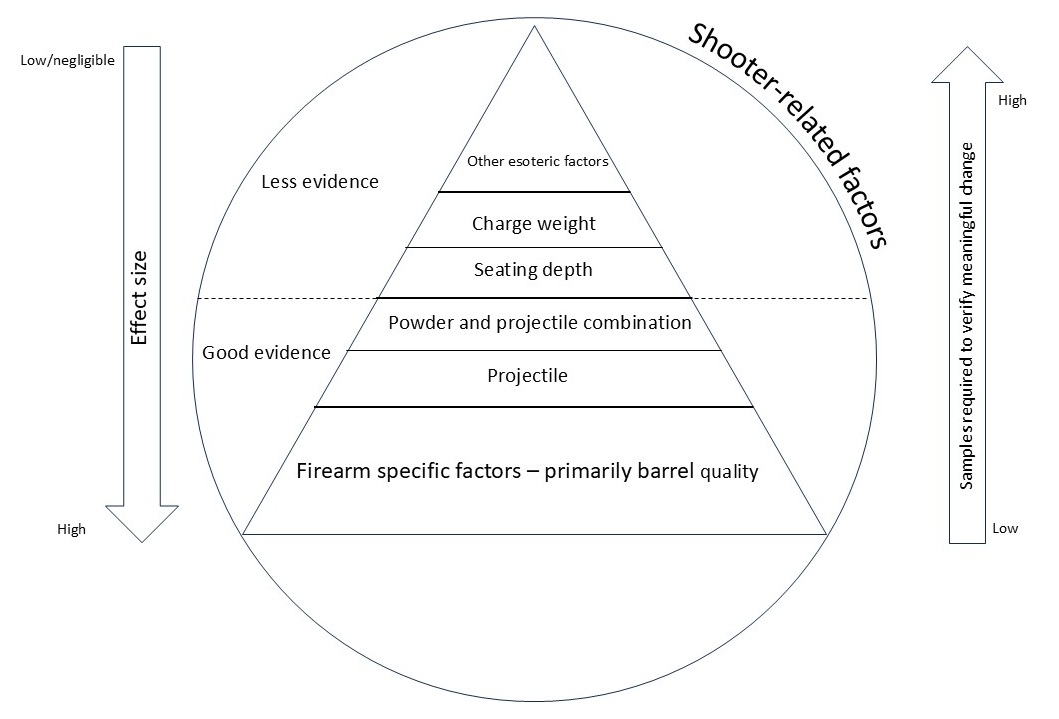
This infographic shows that, based on the data set i have here, for most factory rifles, precision will be mediocre with most factory ammunition. Vs a custom.
I'm not sure an individual needs to understand a baseline for their rifle with good factory ammunition, so much as set a clear requirement for precision - and if unable to meet it, change bullet/powder, and if that ultimately doesn't work - change something on the gun. It's sadly true that if you really want good precision you're likely to have to Pay.
What is a realistic requirement? It comes back to hit probability.
Here's a ~2MOA true cone of fire rifle with average ballistics, modelled for hit % on a 250mm (ten inch) target at 400m - mechanical factors only, no shooter error.
What does a 2MOA true cone of fire look like as a 3 rd group? Impossible to say - it will be tight, but then again, a 3.5MOA cone of fire system produced 1.2MOA avergae across 10x 3 shot groups for me. A bad group tells you it isn't good, but they're less likely, and a good group doesn't tell you anything.
10rd group? Anything between 1.25 and 1.75 MOA. But, being in that range doesn't mean you have the required precision, but you can have a lot more confidence that you do. Better to use mean radius from a 10rd (min) group and aim for 0.14MRAD or less.
Conventional range hunting is very forgiving for precision requirements
Welcome guest, is this your first visit? Create Account now to join.

Welcome to the NZ Hunting and Shooting Forums.
Search Forums


User Tag List
+ Reply to Thread
Results 31 to 45 of 70
Thread: Variables affecting precision
-
14-07-2025, 06:21 PM #31By Popular Demand

- Join Date
- Dec 2011
- Location
- The Big H
- Posts
- 10,891
Peashooter likes this.
-
-
14-07-2025, 07:08 PM #32Member
- Join Date
- Sep 2022
- Location
- Carterton
- Posts
- 762
I'd be very happy with a 2 MOA cone of fire for my rifle, especially if I was shooting it. That's my goal for reloading. A good discussion for a new reloader.
Sent from my SM-G973U using Tapatalk
-
14-07-2025, 07:18 PM #33By Popular Demand
- Join Date
- Dec 2011
- Location
- The Big H
- Posts
- 10,891
Shooter error on a flat range well rested testing loads is very different from shooter error in field positions at longer range, etc. The former should be consistent and fairly small in effect size, the latter.... less so.
Peashooter likes this.
-
14-07-2025, 10:55 PM #34Member
- Join Date
- May 2023
- Location
- New Zealand
- Posts
- 285
The load was tuned using powder charge and seating depth. Originally Posted by gimp

Since each group was shot in different wind conditions and you only had 7 min to shoot the 5 shot group each group may have landed in a different area on the target, wind does affect where a bullet lands on a target, even at 100yds.
When you overlay the groups you end up with an aggregate size of the 5 x 5 shot groups as indicated.
There were NO discarded loads or shots, ALL shots on the target were measured.
Since there were more than a dozen people witnessed these groups, I have more belief in the performance of the rifle and shooter than what someone tries to infer that wasn't there.gqhoon likes this.
-
15-07-2025, 09:49 AM #35By Popular Demand
- Join Date
- Dec 2011
- Location
- The Big H
- Posts
- 10,891
Of course wind shifts POI, however, in my experience and data, 3- or 5- shot groups shift poi quite a lot even in zero wind conditions. This makes sense. You're taking a 3 or 5 round sample from a larger population. If you believe otherwise, what is your theoretical explanation for why a 10 or 20 round group will (almost always) be larger in size than a 5 round group ? It's simple - you sample more of the population and hence the spread.
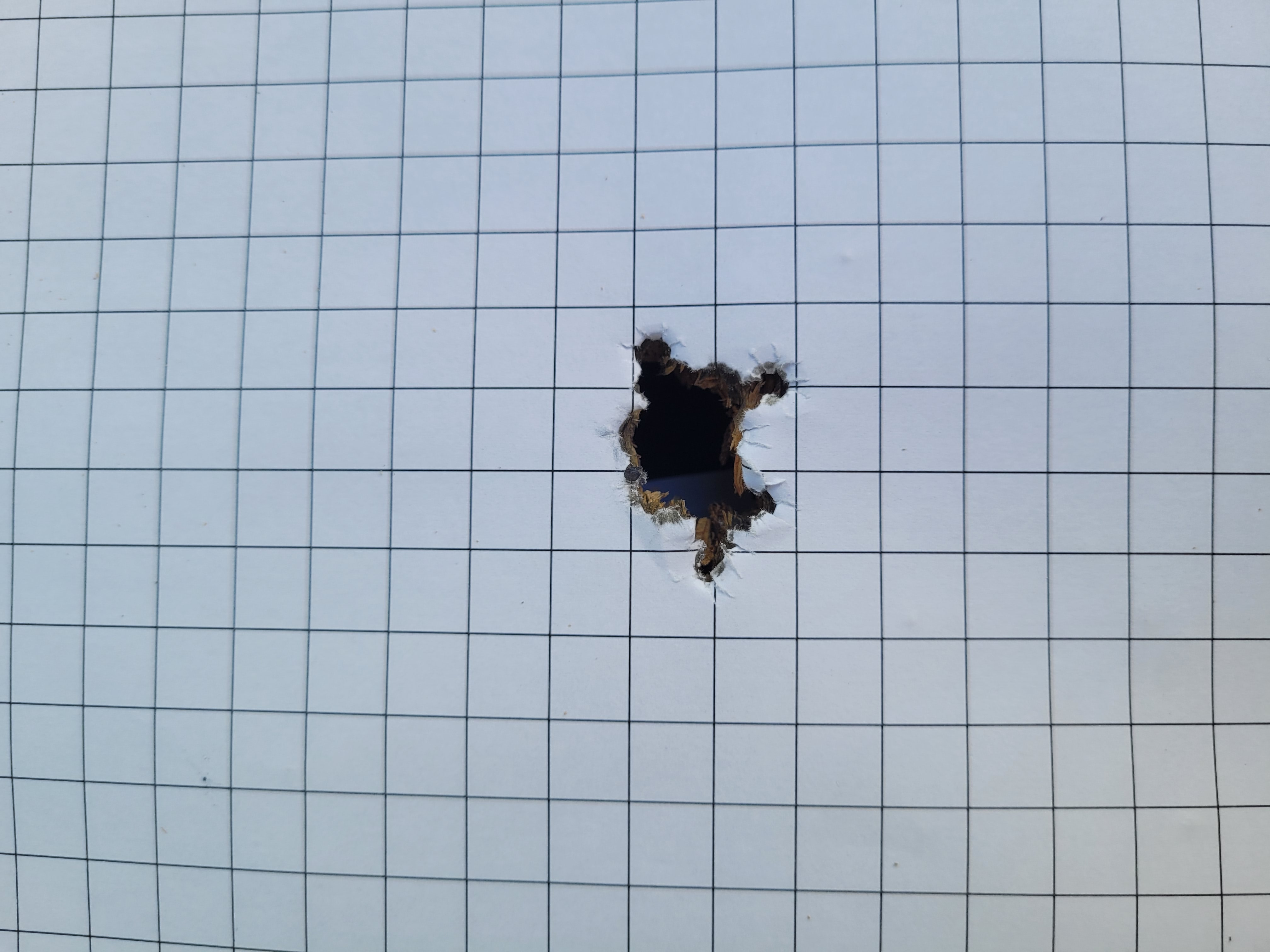
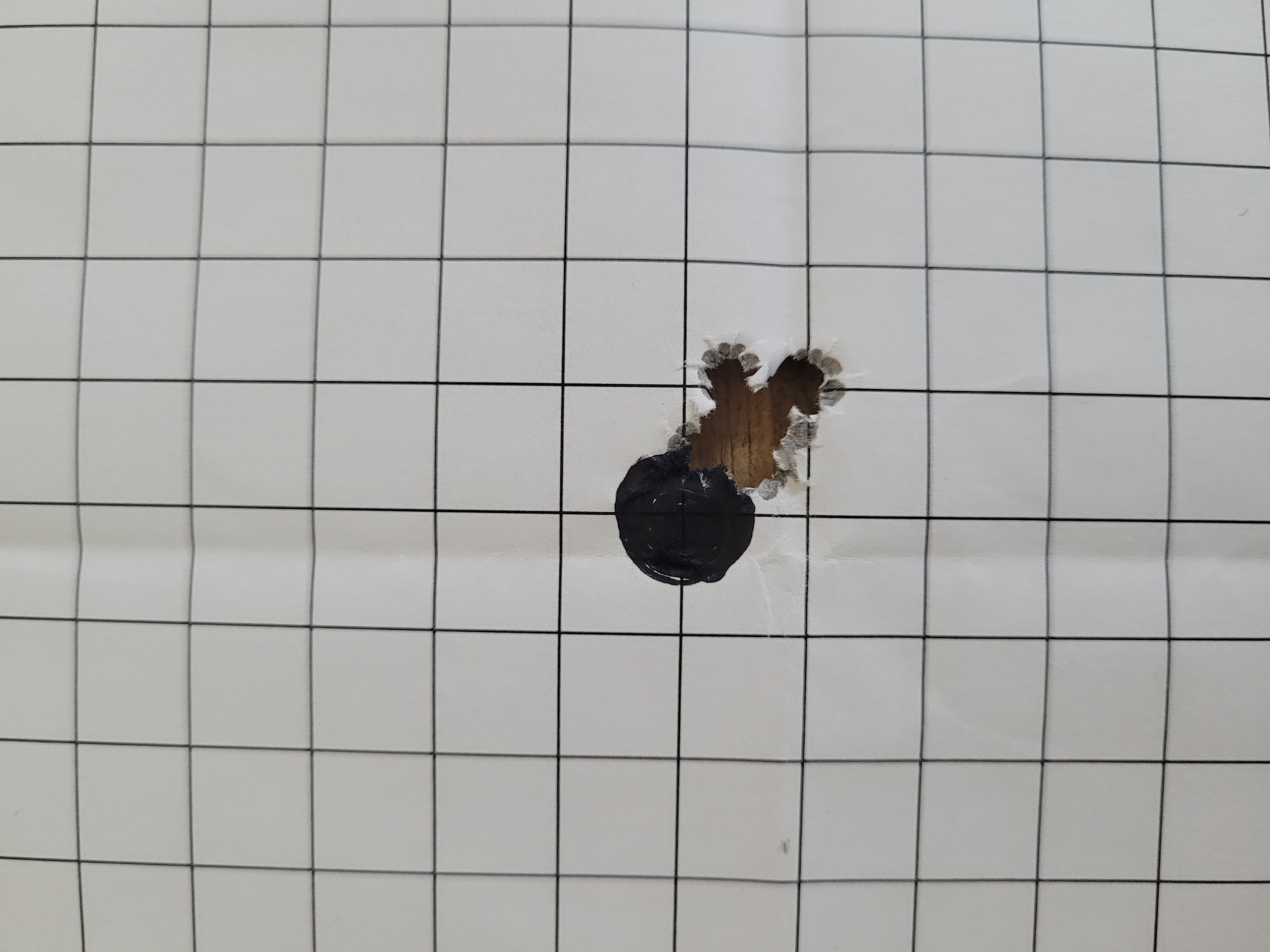
for example here is a 20 round (0.9 MOA) group at 100 metres.

Here is one of the 5 round groups that were shot on a target pinned in front, to generate the 20 round overlay. Note the average ("aggregate") group size was about .49MOA, smallest 0.34 largest 0.66. The load was totally random and un-tuned. Book max of 2206H in FL sized brass with no other prep, seating depth whatever the die was set at for another bullet. No testing.

It's clear from this and any number of other examples that overlaying including POI is not the same as the bench rest aggregate. Aggregate is an average size but disregards position, thus it describes the true precision poorly, and only functions as a "relative index".
When I say "discarded" - I mean loads discarded in the load tuning process. My current understanding based on the evidence I can find is that "load tuning" processes get you to a good load in spite of the process, rather than because of it.
The test of a load development process is not "does it allow me to get a good load" but "does it allow me to distinguish whether loads are actually different"
So far, I have been unable to determine any real precision difference between loads using the conventional tuning approaches with small group sizes, when tested with larger groups.
The apparent differences go away when you take a more valid sample. Which of course makes sense conceptually when you think about taking sub-samples from a larger population.
It's clear that in some cases seating depth (particularly large steps) and powder charge do affect precision, but it's not clear that the effect size is very large at all, detectable practically, or necessary to fiddle with to get a load that is practically functional for any use.
If you have evidence otherwise, please post it so we can all understand - evidence in the form of targets, because "show me don't tell me "Tentman likes this.
-
15-07-2025, 10:00 AM #36Member
- Join Date
- Jul 2012
- Location
- Invervegas
- Posts
- 6,529
You'll get "crickets". Hes not talking about groups he shot, he has never posted a picture of his or any of these "world class" tuned load groups. This makes the whole thing dependant on somes memory and just from my own I know how fallible that is
-
15-07-2025, 10:01 AM #37By Popular Demand
- Join Date
- Dec 2011
- Location
- The Big H
- Posts
- 10,891
He's a BR competitor and I respect that experience and would like to understand how we can, together, build a better understanding of this stuff for the community. Originally Posted by Tentman
Eat Meater likes this.
-
15-07-2025, 10:09 AM #38Member
- Join Date
- Dec 2011
- Location
- NI
- Posts
- 14,910
Understood. Good shooting. Originally Posted by gimp
Restraint is the better part of dignity. Don't justify getting even. Do not do unto others as they do unto you if it will cause harm.
-
16-07-2025, 06:51 PM #39By Popular Demand
- Join Date
- Dec 2011
- Location
- The Big H
- Posts
- 10,891
Another piece to consider would be handloading equipment quality and consistency of process. It's another area of diminishing returns and mysterious voodoo, as you get the pareto 80 with a cheap press, mass market dies, and thrown charges. Originally Posted by earplay
earplay likes this.
-
16-07-2025, 10:32 PM #40Member
- Join Date
- May 2023
- Location
- New Zealand
- Posts
- 285
There are never any zero wind conditions, just those you can see and those you can't see. Originally Posted by gimp
In competition when the flags aren't moving I have seen people shoot BIG groups and think their gun/scope or something is broken, of course when the flags start moving and they shoot several good groups it shows they couldn't see what was making their bullets move all over the place.
If you aren't using some form of wind indicator when shooting all you are doing is guessing and being oblivious to something that affects the bullet, remember wind can blow bullets into a group as well as out.
The groups I was referring to were shot using a factory Sako in 223Rem, I have seen this rifle perform in competition more than once and the results were pretty similar both times.
I wouldn't have a clue how many different loads he tried before ending up with the final load but that load performs very well in that rifle, and he used the standard Benchrest tuning method of seating depth and powder charge to end up where he did.
I cannot take photos of those groups because the person that shot them has them, not me.
With a Benchrest rifle you can see the difference in seating depth and powder charge, and it is definitely more noticeable and repeatable than with the factory rifles I own and even more noticeable and repeatable at 200.
There are some who have joined the Benchrest group and bought Benchrest rifles because their custom rifles weren't as consistent as they thought they should be, I need to ask them if they find the Benchrest rifle is more consistent.
I can only comment about the rifles I shoot and what I have found.
gimp, perhaps you need to sit behind a Benchrest rifle and try it, experiencing the actual results will tell you more than listening to someone else, my offer is still open.woods223 likes this.
-
16-07-2025, 11:06 PM #41Member
- Join Date
- Feb 2016
- Location
- Marlborough
- Posts
- 1,498
"With a Benchrest rifle you can see the difference in seating depth and powder charge, and it is definitely more noticeable and repeatable than with the factory rifles I own and even more noticeable and repeatable at 200."
Following on from 19Badger there are F-Open shooters that say the same and I have seen similar at the range with shooters experimenting with seating depths in real time using precision K&M Arbor Press and Wilson seating dies.
"If you aren't using some form of wind indicator when shooting all you are doing is guessing and being oblivious to something that affects the bullet"
Likewise just because you think there's no wind doesn't mean there isn't. Again, have seen this at NRA ranges. Te Puke was one earlier this year. 300 yard range, wind flags were showing bugger-all movement but there was quite a crosswind at targets where there were no flags. Could see affecting freshly grazed pasture if looking hard enough.19Badger likes this.
-
16-07-2025, 11:34 PM #42Member
- Join Date
- May 2023
- Location
- New Zealand
- Posts
- 285
While the reloading equipment can matter the consistency of the process, to me, is the biggest contributor to accuracy. Originally Posted by gimp
A straight press and dies that create straight ammunition is the foundation, if your equipment makes "bent" ammunition consistent process won't fix it.
I have made competitive ammunition with mass produced sizing dies, Redding f/l bushing die and a Wilson seating die.
Most of the "Custom" reloading equipment is nice to have but it doesn't make any better ammo than a good press and good mass produced f/l die and straight line seater.
The best thing about a lot of the Custom reloading equipment is its smaller, lighter and easier to travel with.
There are many people who still throw powder charges and win, but it is the consistency of their powder measure and the way they use it that allows this to happen.
I am talking about 100, 200 & 300 Benchrest, which is where I have the experience and knowledge, mid range BR and Long range is different.
I, and all the Benchrest competitors I know, use the powder charge and seating depth to tune their load to the rifle/barrel, not everyone seems to know how to do that or what to look for.
Read the following books, Book of rifle accuracy - Tony Boyer, Extreme Rifle Accuracy - Mike Ratigan, Ultimate in Rifle Accuracy - Glenn Newick, The Accurate Rifle - Warren Page, Reloading Guide - Precision Shooting, Precision Reloading & Shooting handbook - Sinclair International, the first two are the most recent publications but they all have relevant information about accurate rifles and reloading.
I do not expect the same results and consistency with a factory rifle as I get with my Benchrest rifle and even custom rifles aren't as consistent as my Benchrest rifles.
I will also add that some of the processes that are required to make accurate ammo for my Benchrest rifle, don't seem to have the same result or aren't a noticeable improvement in a factory rifle.Last edited by 19Badger; 16-07-2025 at 11:58 PM.
-
16-07-2025, 11:34 PM #43Member
- Join Date
- Mar 2022
- Location
- Catlins
- Posts
- 653
I think we should get @gimp’s mate, Dennis, in on this conversation.
outdoorlad and Woody like this.“Age is a very high price to pay for maturity”
-
17-07-2025, 09:51 AM #44Member
- Join Date
- Sep 2022
- Location
- Carterton
- Posts
- 762
I've heard enough to get a good idea of how far I need to go to get a consistent hunting load, and the factors outside that that affect precision. OP's job done. Originally Posted by gimp
Sent from my SM-G973U using Tapatalk19Badger likes this.
-
17-07-2025, 10:47 AM #45Member
- Join Date
- Dec 2024
- Location
- Manawatu
- Posts
- 298
The pareto principle is a good way to summarise a lot of what is being discussed here. Seems to be a common pattern across many other hobbies in my experience, particularly those with technical details/variables that are manipulated to effect an outcome. My interest is in how do we best communicate the vital 20% (admittedly part of the challenge is agreeing on what these factors are to begin with). Originally Posted by gimp
To your earlier points - I think in some ways we are both talking about 'setting expectations' as a starting point, just in different ways. I think setting a precision goal based on relevant metrics makes more sense than what I was suggesting. I guess that may still need to be tempered by knowledge of what realistic precision looks like, especially in an off-the-shelf hunting setup. (I'm not so much thinking about benchrest etc as assume those folk already have a pretty good handle on the important stuff and are probably working at a much higher level of resolution).


 Reply With Quote
Similar Threads
-
Old Ammo Affecting Rifle Accuracy?
By Copelli in forum Firearms, Optics and AccessoriesReplies: 7Last Post: 11-05-2024, 12:31 AM -
WTB: 7mm rem mag Precision die set
By Hubt.nz in forum Reloading and BallisticsReplies: 0Last Post: 10-05-2020, 08:53 AM -
Bipod affecting accuracy.
By Finnwolf in forum Reloading and BallisticsReplies: 33Last Post: 24-08-2019, 05:33 PM -
Shooter variables
By Cartman in forum ShootingReplies: 16Last Post: 14-11-2015, 09:57 PM
Tags for this Thread

 Posting Permissions
- You may not post new threads
- You may not post replies
- You may not post attachments
- You may not edit your posts
Welcome to NZ Hunting and Shooting Forums! We see you're new here, or arn't logged in. Create an account, and Login for full access including our FREE BUY and SELL section Register NOW!!
All times are GMT +13. The time now is 07:13 PM.

Bookmarks