yards, of note the targets are not to scale despite the PDF saying they are....Quote:
Originally Posted by gimp

Printable View
yards, of note the targets are not to scale despite the PDF saying they are....Quote:
Originally Posted by gimp
And here is the latest evidence this approach just plain works. A 6mm ARC barrel that I'd shot for 200 rounds or so, showed promise as an ARC with the 103s but never "properly tested". Rechambered to 6mm CM.
Taken to the range last night and a ladder shot up to book max. The results analyzed using GRT (calibrated to the resultant case capacity and actual velocity etc.). It suggested an additional 50-100 fps was still on the table. Not wanting to run this rifle "hot" I rounded the load up to an even number and confidently loaded 50 rounds.
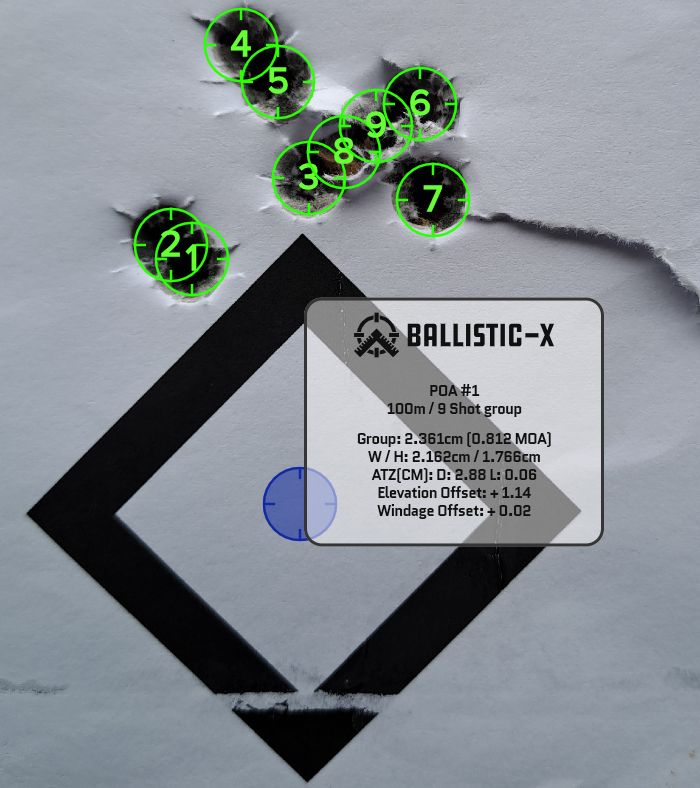
At the range this arvo to test and here are the results, which include the cold bore shot - I got interrupted hence finished at 9 shots. All good for hunting to 500M
Attachment 255452
Note that the shot order is not as labeled, the cold bore shot is in the middle of the group, maybe #8
I did get humbled a bit later, we went to 571M to shoot some gongs and despite a solid zero from the above group I cocked up the settings between the scope and Strelok and couldn't hit the 6" gong to save myself . .,. It did eventually get sorted but shows how many things can go wrong in this LR game
I just found this thread. Its very interesting and a great practical example of the Hornady #50 and #52 podcasts I watched last week. Thanks @gimp for taking the time to do the test and share it.
I have a new rifle that I plan to load for using this method. Let's just say I settle on a load after 50 rounds. I understand that barrels speed up over the first 100-200 shots. Traditionally this would require retuning the load to get back to the "velocity node". In reality though, the velocity increase should be no real concern accuracy wise and I seem to recall the Hornady guys saying there is no correlation between velocity and accuracy. So it'll just be a matter of keeping an eye on velocity over time to make sure I'm making appropriate allowance in my ballistic calculator for long range work. Have I got the right take on that?
Cheers
I recently got a new rifle. I picked a load at book max of 2209. At 200 rounds it is 50fps faster than 0 rounds. The precision is no different.
When I say I "picked a load", I mean -Quote:
Originally Posted by gimp
I set the seating die so that the bullet is some distance off the lands and the COL is around the book max COL - not sure how far off the lands maybe 30 thou
I loaded 30 rounds, 10ea with 2209, 2208, and an old slow batch of 2209
I shot 3 10 round groups
All were fine for precision but the 2208 and the old slow batch of 2209 were a bit slower than my requirements
I then proceeded to select a max load of 2209 as my load at that random OAL, and use it.
Over the first 200 rounds it seems to have sped up around 50fps, precision hasn't changed.
As no-one else has repeated my "test of the test" - we can't say categorically that you should expect the same with every rifle, cartridge, bullet, powder combination - but I haven't seen any evidence to the contrary yet.
Cool, thanks. Coincidentally I will be using 2209 aswell.
Cheers.
Thought I’d come back and re-read. Definitely changed the way I do things
I managed to get to the range last night. Put 70 rounds of "load development" through the 223. Used a hybrid approach effectively a quick test of seating depth to see if I noticed any difference and to use the last bit of some old 4895 I don't trust. Then a quick exclusion test with various powders to exclude any options from further consideration (5 shots cant confirm a good group but inverse probability can highly suggest its not worth continueing with . I'm going to start a thread following this rifle as I have a few hundred bits of brass and intend to test a bunch of things for myself. I will try record it all to post on here. A summary was I shot 3+inch 5 shot groups as well as 4 consecutive submoa 5 shot groups with 4 different powders and charges that overlaid fall in 1.1moa for 20 shots. I think it's going to highlight the fastest reloading solution is to change components
Please post up the data! Very interested to see
That's the plan. One thing I see straight of the bat is it doesn't like the 75s like the Tikka did.Quote:
Originally Posted by gimp
A wee thought on this. The results are still a bit subject to "other factors". My 223 full length die has been on the same "setting" for years. My last two 223s didn't really perform as well as I expected. Then the latest one gave me a series of light primer strikes, no bang. Hmmm, it's a very well built rifle, everything should be good, what's causing that? I checked firing pin protusion, all good. Headspace is the next suspect, so a trip to the gunsmith, hmmm that's within tolerance as well, the"no-go" wouldn't drop.
A real big Hmmmm. So after some more thought I got a comparator and measured the should length of some fired, factory and reloaded rounds. The measurements are relative but most factory ammo hovered round 2.507" Fired cases from the last two 223s a very consistent 2.514. My sized cases, 2.505 to 2.507 ( including the light pin strike ones). So I dug through some old cases until I found some that were measuring 2.511+, neck sized them and presto, accuracy improved, and the light strikes vanished.
Funnily enough both current 223s have exactly the same chamber length, and both improved accuracy.
My dies must have been like it, potentially causing issues, for at least 5 years since I got a co-ax press.
Sure, a reloading process/quality error like that could mean that you'd struggle to "find a good load" at all. However tuings like that are a constant across all loads trialed and don't at all detract from the investigation of whether or not conventional load development methods work. It's a separate issue like whether or not your rifle is junk. I think right back at the beginning I recommend avoiding these issues by having a very high quality rifle system and using the best components.Quote:
Originally Posted by Tentman
Quite surprised theres not much focus on seating depth here. Remember watching a podcast with eric cortina and jack nerry (i think his name was) one f class the other benchrest for team lapua. Talking about seating depth has a direct relation on group size, testing in 3thou increments. A example of this is when people buy factory ammo to test what there rifle likes that is the seating depth of the different ammo that determines the better groups.
I think his way of load development makes sense, first stage over chony, no target to distract you, find lowest es
Once powder charge found on to seating depth testing
@Hunterdave
Get ready for the "Statistics only" crowd to get rev'd up again :omg: ;)
Admin please remove meQuote:
Originally Posted by Roarless20
Cortina's are so last year. They don't even make them any more.Quote:
Originally Posted by Hunterdave
You are assuming that factory ammo brands all use the same powder.
I test powders before I fiddle with length (if ever). Mag length and a couple or three powders at near book max. Usually one of them works. Chrono when it's all over and adjust the charge for target velocity. Then go hunting.
I stopped watching him ages ago.Quote:
Originally Posted by Tahr
I’ll change my mind when some of you guys go shoot some minimum 10 shot seating tests with 3 thou increments. There’s no way you’re seeing anything concrete with 3-5 shot seating depths tests with minimal length changes. Kidding yourselves.
Even easier way to test, load up 15 at your seating depth sweet spot you’ve found and shoot 5 x 3 shot groups at same seating depth. If it works, they should all have similar point of impact and similar group size.
Haha well they are at the top of their fields and obviously very experienced reloaders so so im sure some would like to learn whatever they can to get the best out of their rifles, as some dont care but each to there ownQuote:
Originally Posted by Roarless20
The podcast I watched did show the testing, I think they were around 9 thou apart, they both do it. John winning in the wind does the same testingQuote:
Originally Posted by McNotty
Ill see if i can find it
No just that any load can be made better at the right seating depthQuote:
Originally Posted by Tahr
Show us your groups . . . Awaiting results with interest!Quote:
Originally Posted by Hunterdave
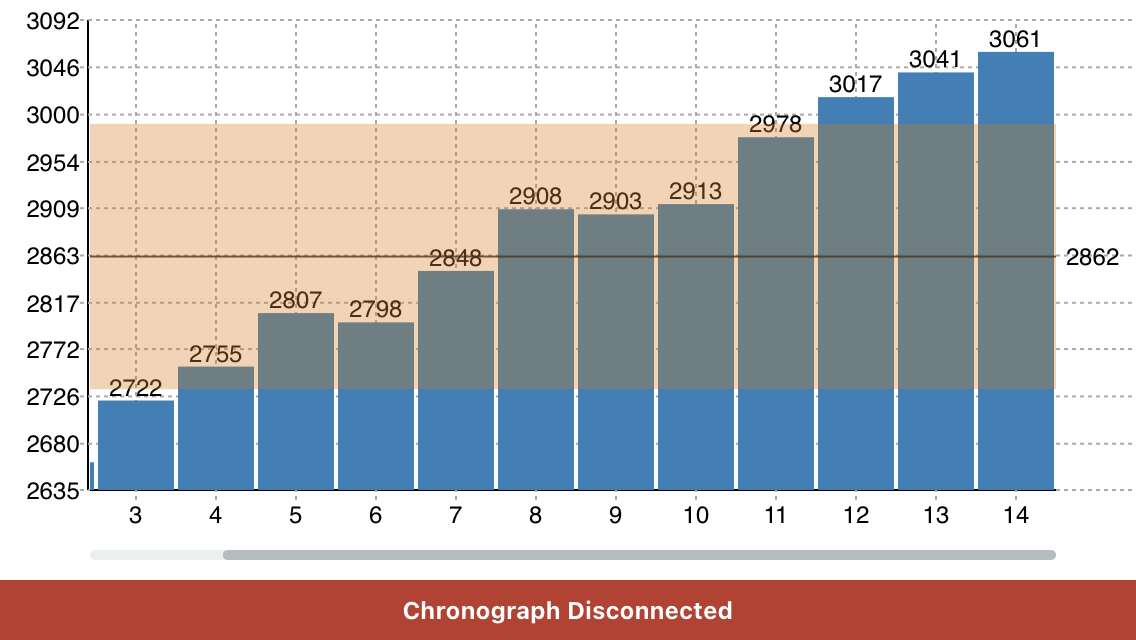
This was my first go at reloading in my last 284, no expert but went on the strategy outlinded. shot a ladder .5 increments over chrony, in hind sight I should have done 3 to see if they replicated. no targets used. Obvious node at bottom and 2903fps. Did another .3 apart around that upper node to see if I could pinpoint where it was. By doing this you can load to upper edge in winter and lower in summer. Went back and I did do seating depth test but don’t have any pictures of it, it was a couple of years ago. Was a tack driver so I was pretty stoked. About to do again so will see how it goes this time
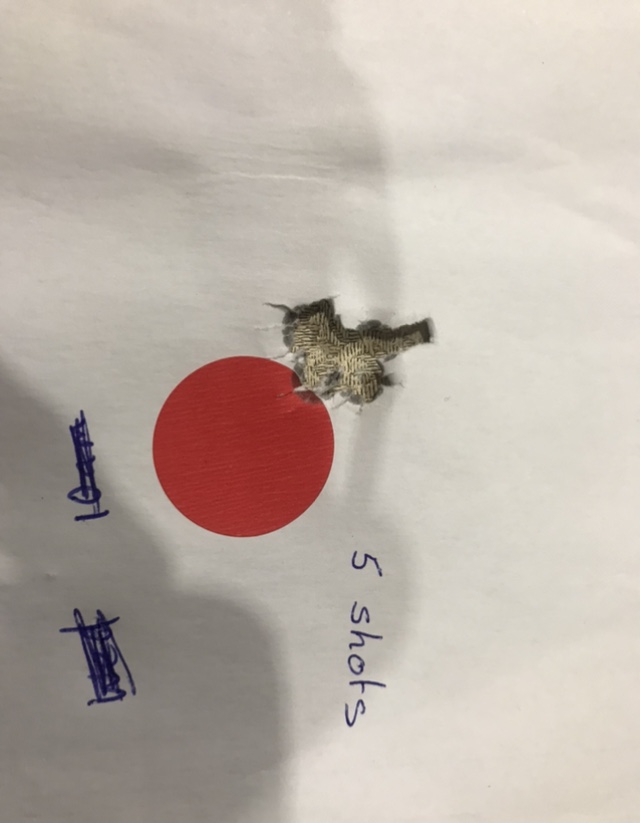
1 5 shot & a couple of 3
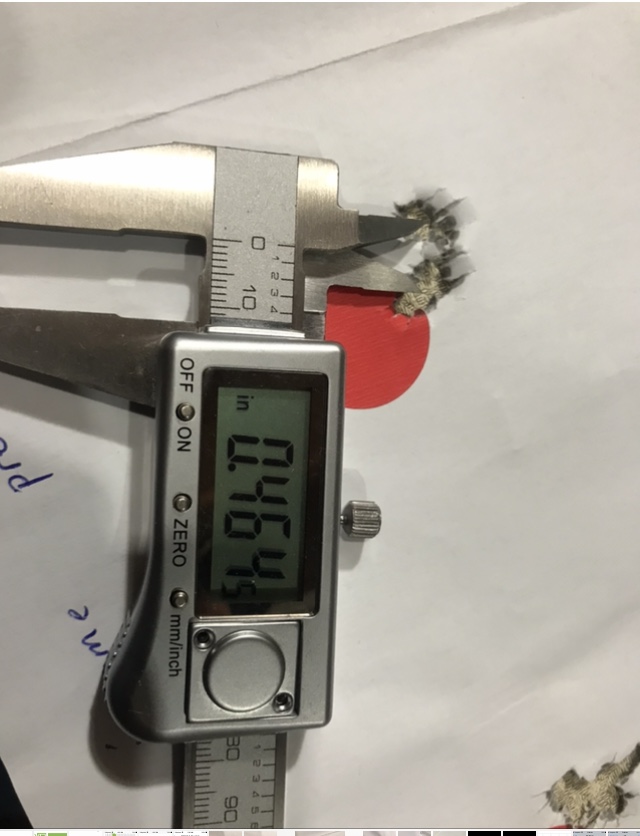
Attachment 270611Attachment 270610Attachment 270613Attachment 270612
https://youtu.be/rFI1DyaBwho?si=U_xmBKrZzSDZ7dO5
Seating depth test
A very precise rifle there! Was it a hunting rifle?Quote:
Originally Posted by Hunterdave
@HunterdaveQuote:
Originally Posted by Hunterdave
The focus is on testing a conventional approach to load development - varying charge weights of the same powder. Do they actually produce different precision characteristics or velocity consistency (when measured properly), and does the conventional process actually work to identify this? The answer appears to be no to both.
The evidence available for the same questions for varying seating depth within the functional window also appears to be no - however if someone wants to test it meaningfully and determine whether or not this is true, I'm interested to see - and will update my position as information is available.
e.g. https://youtu.be/_h4iAiGYbwg?si=uEfJaoLj_D7HAjvv
However, it also has become apparent that "optimisation" approaches to load development are extremely inefficient, and a "requirements" approach gets you something functional a whole lot faster and with more confidence.
Requirements.....now there is a concept I can relate to.after all,good enough is well...good enough lmfao
Man, I just got shooters fatigue reading this thread :)
Good enough for what your doing sure but that can vary quite a bit. Whats good enough for someone at 200m might not be good enough for someone else that wants to stretch out furtherQuote:
Originally Posted by Micky Duck
That's why I dual load.... Or at least carry a few of load that is better than others. For run of the mill stuff I'm happy with run of the mill loads.
Yeah, I definitely carry subsonic and supersonic for the 30/30.Quote:
Originally Posted by Micky Duck
All the more important to really understand then, isn't itQuote:
Originally Posted by Hunterdave
So I have a box of 68gr Hornady BTHP Match .224" bullets on the shelf. There are 85 bullets. I don't know where the other 15 went, but the box has been there a long time.
I decided to tune up a load with these so I can use them.
CCI 450, some ADI brass FL sized.
2206H - book max of 26.0gr listed as compressed and 3069fps from a 24" bbl. I'd expect maybe 2950 from an 18" at that load and pressure. Loaded just touching the lands.
Loaded 6x sets of 3rd, from 24.5gr up to book max.
Here's the results:
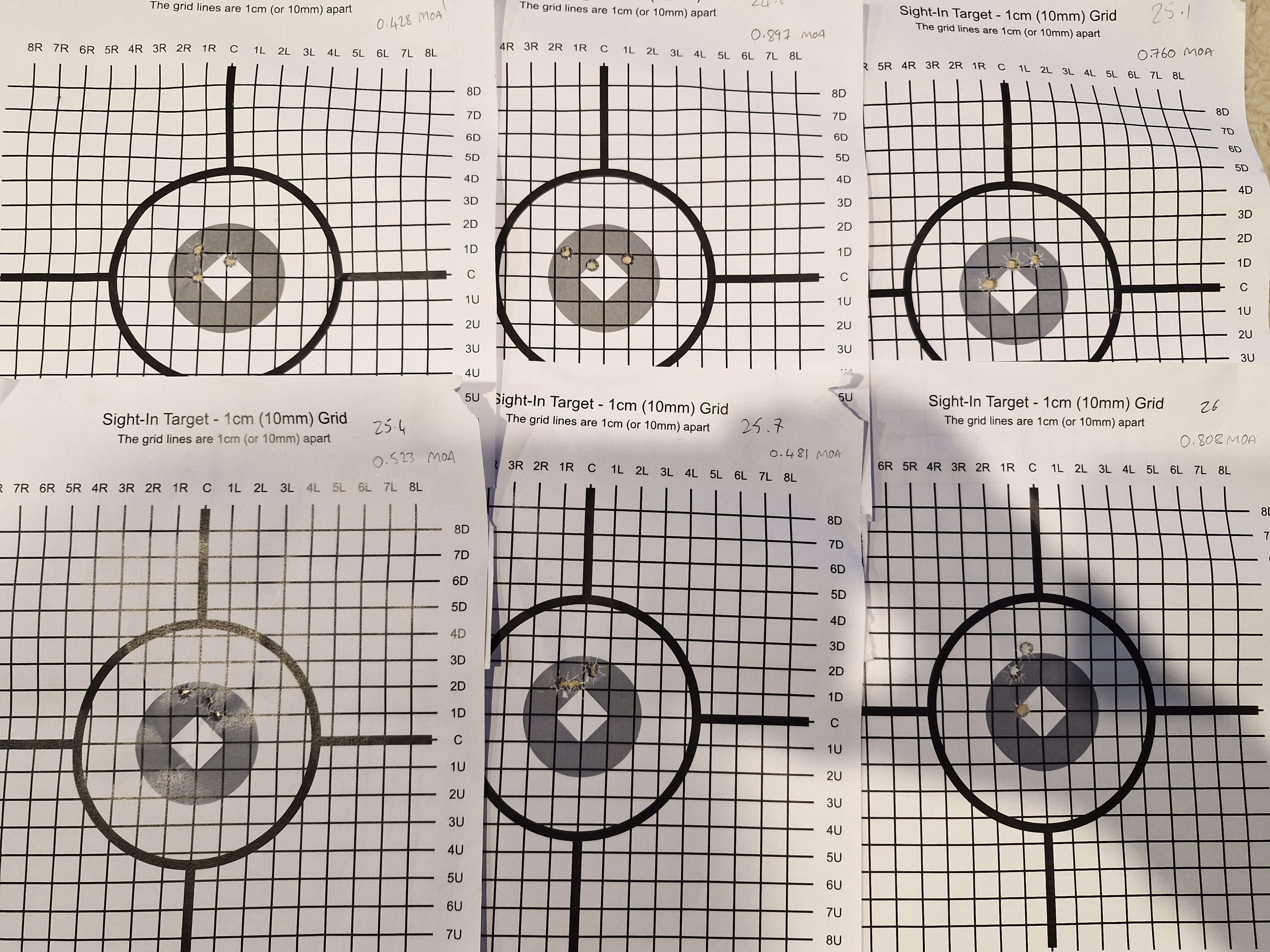
Attachment 271781
24.5: 2876fps avg, SD 6.7, ES 16.2, group 0.428MOA
24.8: 2926fps, SD 10.3, ES 22.2, group 0.897MOA
25.1: 2950fps, SD 5.1, ES 12.5, group 0.760MOA
25.4: 2999fps, SD 11.3, ES 25.1, group 0.523MOA
25.7: 3036fps, SD 11.3, ES 28, group 0.481MOA
26.0: 3069fps, SD 17.7, ES 42, group 0.808MOA
Based on book velocity, I'm probably hitting SAAMI max pressure about 25.1 - 25
4 grains. I expect the ADI brass is a bit thick and I certainly wouldn't load up to 26.0 as the load was becoming heavily compressed.
In the interests of selecting the best load to tune, I think it's 24.5gr - after all, it has the smallest group and a nice low SD/ES.
So following the seating depth tuning method, I loaded 6x 3rd sets of 24.5gr, in 0.003" deeper increments. Not repeating the same depth at just off the lands - so that's a 7th sample. There's a functional window for any bullet in real life, and with this case/powder/bullet combo it starts to get pretty crunchy as the OAL shortens up. I could keep going with more loads at a shorter OAL - but let's see how these tune up.
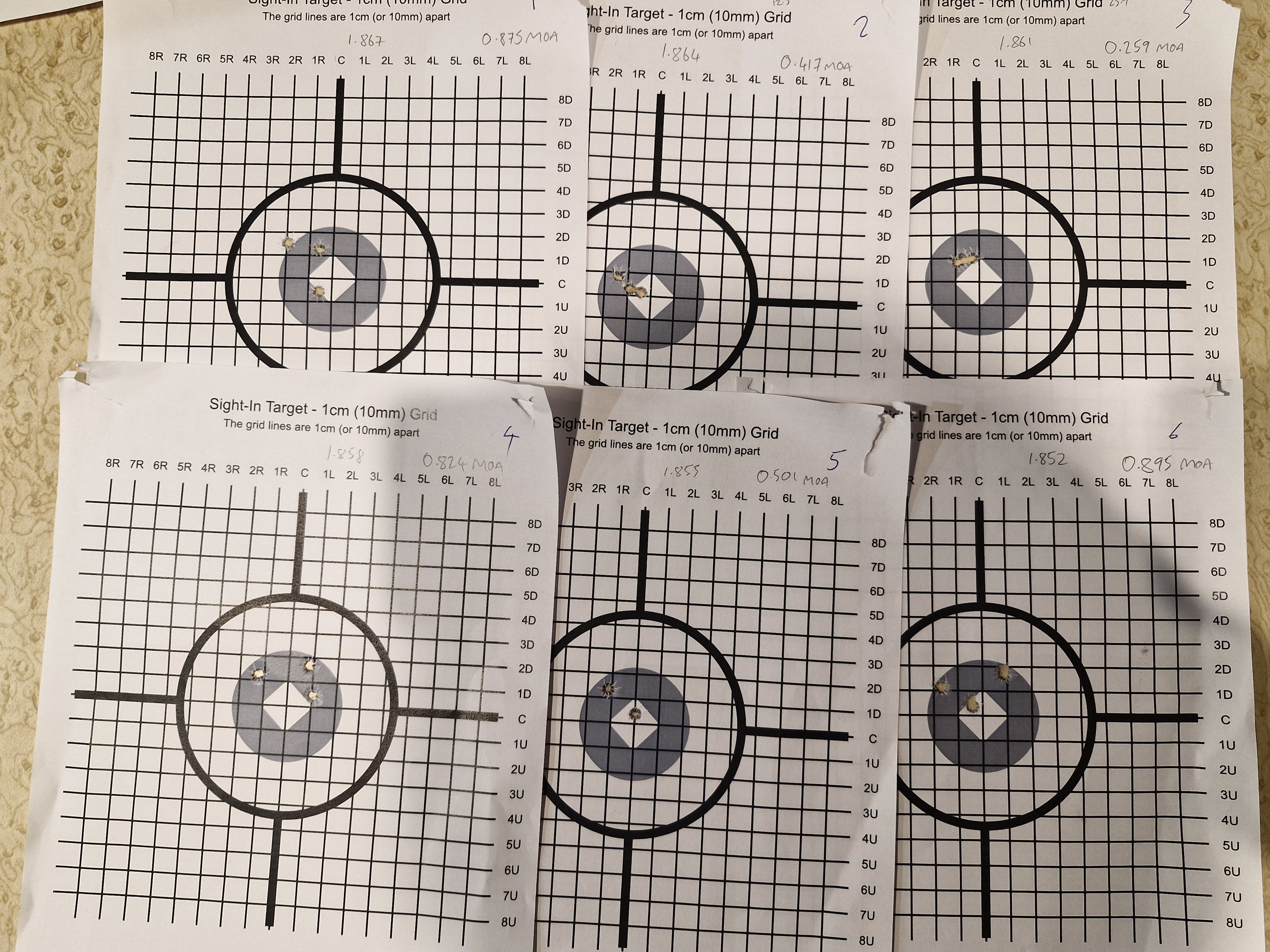
1.867 - 1.852 CBTO.
Here are the results:
Attachment 271782
So I have a good tight group at 1.861" CBTO. It's also a nice group at .003 longer than that. Is it a node? Have I tuned a good load up?
CBTO/VelocitY AVG/SD/ES
1.870, 2876, 6.7, 16.2
1.867, 2866, 4.9, 11.7
1.864, 2857, 12.5, 29.5
1.861, 2867, 10.6, 25.9
1.858, 2858, 10.0, 23.2
1.855, 2862, 19.0, 42.8
1.852, 2854, 3.0, 6.6
So - what now?
Can't wait for the first bite . . .
Genuinely - advocates of tuning - which load do you think is the best and the worst ? Should I do any further tuning? What can I expect in the future?Quote:
Originally Posted by Tentman
I've fired 38 (don't ask about those 2) of my 85 bullets - so I have 47 left.
Seriously, with only 47 left, why don't you load them all at 1.861 and go gather some meat?
Life's too short.............
You pick the best group, and the worst group and load up 10. Or even better 20 of each, and get back too us.Quote:
Originally Posted by gimp
I’d love to see you load up 10 each of the “worst” or “best” four lengths and shoot them as two 3 shot groups and one 4 shot group and show those results as individual groups for each length, then show them as a combined 10 shot group.
1.861 should continue to print those nice tight groups if the tuning theory is correct.