

 62Likes
 LinkBack URL
 About LinkBacks
"Insanity is doing the same thing over and over again, and expecting a different result" - Albert Einstein. maybe.
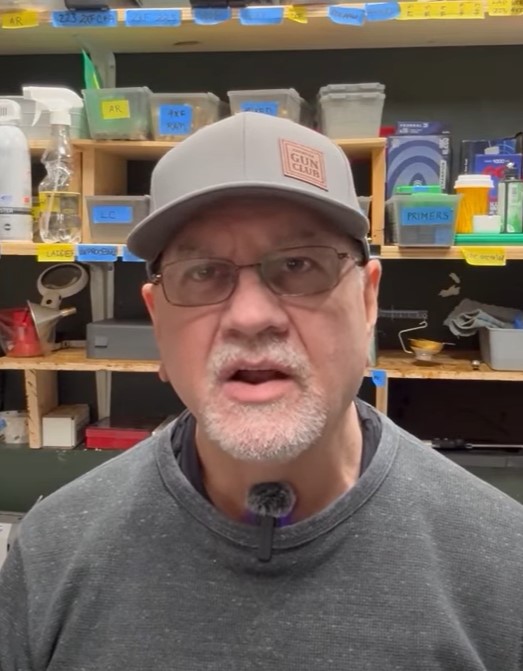
I'd like you all to meet Dennis.
Dennis is an older gentleman, based somewhere in the Southern states of the USA, perhaps Georgia, and the mastermind behind the "Everyday Reloading and Shooting" youtube channel.
https://www.youtube.com/@EverydayReloadingandShooting
Dennis owns a Tikka T3 .223, and a Sako S20 6.5 Creedmoor, and Dennis is a load development enthusiast. Dennis has undertaken many thousands of shots of load development, following conventional tuning processes, videotaped the results, and uploaded them to youtube for everyone to enjoy. This creates, if you can ignore his tortuously-absent-any-factual-basis mis-use of mean radius, a treasure-trove of data for a case study on understanding the effectiveness of those tuning and load selection processes for actually identifying whether any of it makes any difference to rifle precision.
It isn't clear for exactly what purpose Dennis is doing all this reloading. He focusses on creating a series of test loads for some particular combination of components and load parameters, shoots those, then reports back on what results were observed, with a wide range of interestingly meaningless metrics.
Let's have a look at some of these. I highly recommend that you absolutely do not watch these videos and instead read my summary.
6.5 Creedmoor Sako S20
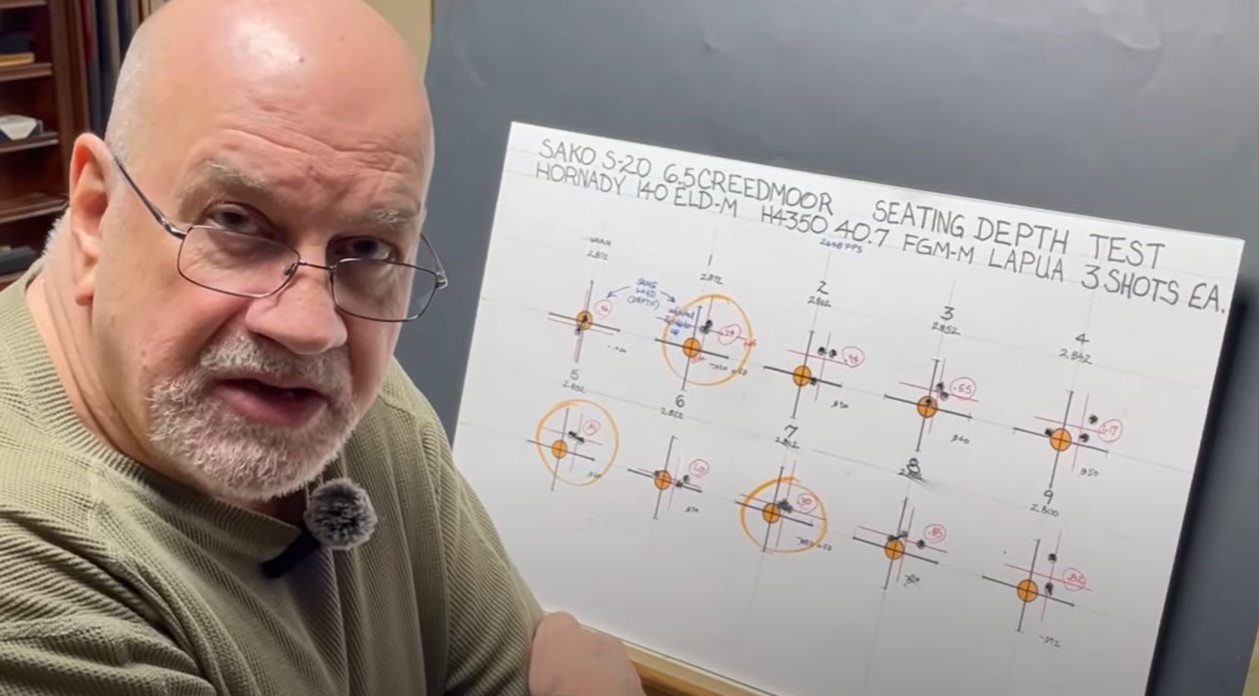
Dennis first determines the distance to the lands for his rifle. He then, using what appears to be a somewhat arbitrary charge weight, seats a range of loads at 0.010" increments deeper starting at 0.020" off the lands. He's using high quality components - lapua brass, H4350, 140gr ELDM, and appears to have reasonable quality reloading equipment. 10 groups of 3 - 30 rounds.
https://www.youtube.com/watch?v=-xBHIKYr6GE
Dennis then goes to the range and shoots these rounds !
https://youtu.be/8c0CnAeNgEU?si=UV4Vfq2BsWH8cAzf
Dennis seems fairly happy with his results.
What are these results?
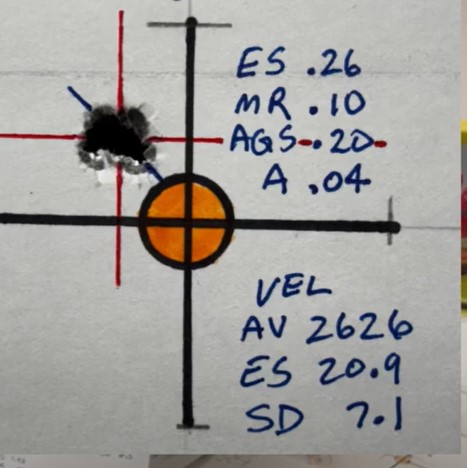
Well, his first 3 shots are "barrel warming and fouling". 0.46" group more or less centred on the X- and Y- axis, just a fracco left. He adjusts 2 clicks up from here. When he fires another 3-round group of the same load, it looks about 2 clicks up, but it's moved out to the right about a click. That's pretty normal - POI wanders around a fair bit between 3-round groups, even in a windless indoor range.
However enough about accuracy, let's look at the group sizes and talk precision
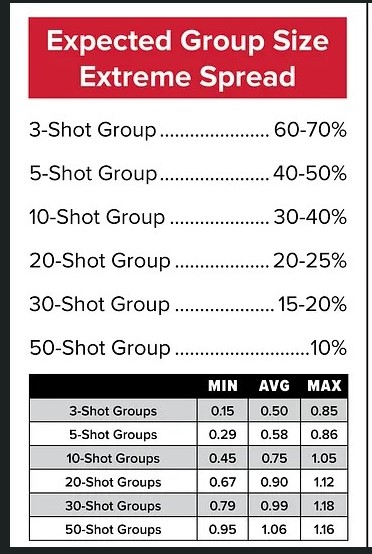
The variation above and below the mean across these is about plus and minus 70%. That's about what you get when shooting 10x 3rd groups of exactly the same load...
Regardless of that bit of foreshadowing, Dennis decides that he might be seeing some nodes at 2.872" and 2.812", and decides they require a bit more testing. Fair enough.
So it's off to the range again, this time to "zero in on the node".
https://youtu.be/J_9e6SEOqHo?si=vNFmNiVOgVk48YiA
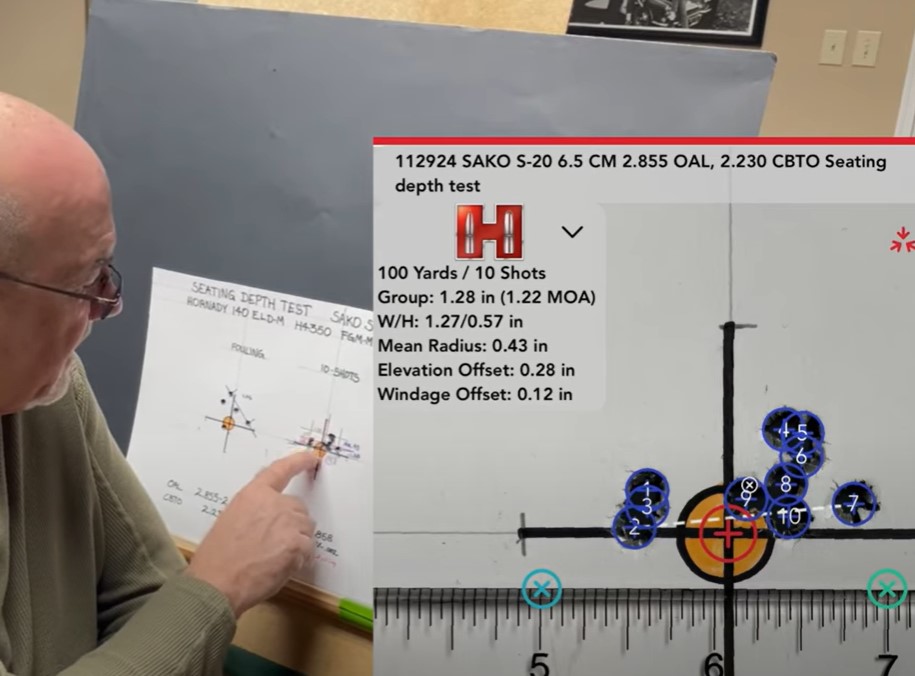
First up, Dennis re-tests the "node" that produced a 0.24" 3-shot group - 0.020" off the rifling. He does, admirably, test this with a 10 round group.
For some reason he's mis-labelled it vs his commentary - data management is a bitch - but unfortunately for Dennis, his tuned node at 0.020" jump doesn't produce what he's looking for - just a 1.28 inch 10 round group. Astute observers at this stage might look at the mean radius of 0.43 inches, multiply it by the correction factor of 4.16, calculate that he should expect a 95% dia of 1.78 inches plus or minus about 20%, note that all his previous shots from testing fall into that diameter centred around a common MPOI, and reconsider the approach or expectations. However, not our man Dennis.
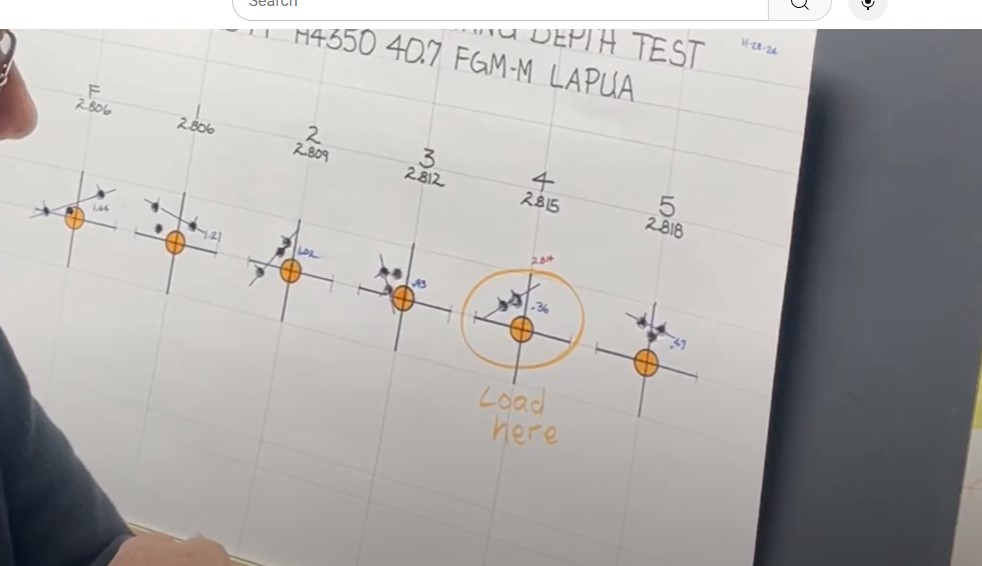
Dennis gets onto his next investigative step - testing a range of seating depths in 0.003" increments either side of the other previously identified, um, node at 2.812". No, it isn't clear why he tested one node with a 10rd group and the other with a series of 3-rd groups. What is clear however, is that he's now 63 shots deep in this load development (including foulers) and hasn't yet worked out what he can expect from any of these loads in the future.
For some reason his POI has shifted a bit. Alarming. He doesn't seem terribly concerned that the seating node he was testing (2.812") produced a group 50% larger this time than last time (0.45" vs 0.3"), but gets on with it and decides that in fact, 2.815" is the magic seating depth that requires more testing. Happy days.
Dennis loads up a few of those, except for some reason seated 0.001" deeper, and heads back to the indoor range. This time he's framing it as instructional - "how to find the node". Good stuff, he's done a lot of shooting so surely he has found it and can tell us how.
https://youtu.be/anwzFsFGiw8?si=QoLYRRqJ2Y1XeTmI
He bangs out a 3 round fouling group, then a 10 round test group. Nice work Dennis. That's shots 64 to 76 on this load development process if anyone is keeping score. Let's have a look.
Hmm. At a group size of 1.18 inches and a 0.39 inch mean radius, there's no evidence that it's any different from the other seating depth above. Bugger. Back to the drawing board for Dennis - spoilers - he's going to have a crack at length-sorting bullets.
This next range trip isn't a very long video. Dennis bangs out a few foulers and one 10rd group. And it's looking pretty good, actually, except for....
...yes, Dennis is very tempted to call that one a flier. Who wouldn't be, after so much effort and 89 rounds of development? The fact remains that if we don't exclude that shot, it is a 1.35 inch group, and the mean radius is inside the range you might expect based on prior groups. Any of these metrics will see some variation around the mean with only 10-shot samples.
Now the chronology seems to get a bit funky with this series. Dennis refers to a video in which he shoots a great 5-shot group with this load. This actually happened much earlier than the rest of this series and it's an odd anachronism. But it appears that some horrible sceptic named Warren (my name is not Warren) challenged him to shoot another 10-rounder with it and see what it looks like. To his credit, Dennis is not afraid to meet this challenge, although it's sort of odd, as he's done a heap of load development since that.
https://youtu.be/wQdPsXPMq4I?si=ZF8SYzSpZFKMG25x
The 5-shot group that inspires this, is this group - it's a quarter MOA. It really shows what the rifle can do, doesn't it?
So off he goes - back to the indoor range, armed with the usual fouling shots and enough finely loaded quarter-MOA precision rounds, length-sorted, for a screamer of a 10-round group. Let's see how that goes.
Well, not a quarter MOA. However, Dennis seems pretty philosophical about it and takes it in his stride. Which does make me wonder for exactly what purpose he's doing all this. It's not clear where to from here with this one for Dennis, but we've now got a record of at least 109 shots of load development, a bunch of different tuning and testing nodes. Which has led Dennis to shoot 4x 10 shot groups, averaging 1.28" and varying about .1" above and below that, which is actually more consistent than you'd normally expect for 10rd groups. All the 3-shot groups fired during the testing process fall inside the general cone of fire described by the 10 rounders.
Interesting stuff, isn't it? And I didn't have to spend a single cent on powder.
Who's interested in some more Reloading Adventures with Dennis?
Welcome guest, is this your first visit? Create Account now to join.

Welcome to the NZ Hunting and Shooting Forums.
Search Forums


User Tag List
+ Reply to Thread
Results 1 to 15 of 41
Hybrid View
-
16-07-2025, 03:26 PM #1By Popular Demand

- Join Date
- Dec 2011
- Location
- The Big H
- Posts
- 10,891
Seeing the light: A load development case study
-
16-07-2025, 03:45 PM #2Member

- Join Date
- Apr 2015
- Location
- Geraldine
- Posts
- 28,139
I got a headache and my wallet slammed shut and locked itself away in bottom ofsock drawer just reading that.... But wait,let me guess the punch line??? He sells rifle and then does it all again perhaps???
75/15/10 black powder matters
-
16-07-2025, 03:52 PM #3Member
- Join Date
- Jul 2012
- Location
- Invervegas
- Posts
- 6,529
I do like his nice drawings etc.
inglishill likes this.
-
16-07-2025, 03:47 PM #4Member
- Join Date
- Dec 2011
- Location
- Perth
- Posts
- 2,250
Lol nice commentary Pete. No I've not watched him, who is Warren though Hmmm.
It's not all of them, but it's always them.
-
16-07-2025, 03:51 PM #5Member
- Join Date
- Dec 2011
- Location
- NI
- Posts
- 14,901
And why is his left hand purple? Originally Posted by nor-west
 Micky Duck likes this.Restraint is the better part of dignity. Don't justify getting even. Do not do unto others as they do unto you if it will cause harm.
-
16-07-2025, 03:50 PM #6Member
- Join Date
- Jul 2012
- Location
- Invervegas
- Posts
- 6,529
Haha. If I recall correctly I put you onto this "nutter", sorry to be blunt but no other way to describe him.
However just be careful, just as he probably has his acolytes, our dear @gimp might have a few too . ... says the guy who has just ordered a Mullerworks 224 1:8 barrel "for experimental purposes!)
-
16-07-2025, 03:55 PM #7Member
- Join Date
- Jul 2012
- Location
- Invervegas
- Posts
- 6,529
At least he does post 10 shot grouos from his Tikka 223. That saved me from buying one, and every now and then I do think of him when I get tempted to try another factory cheapie 223.
-
16-07-2025, 05:07 PM #8Member
- Join Date
- Jun 2013
- Location
- Middle Earth
- Posts
- 4,948
Hey gimp,
Take a look at the little crow gunwork load development, if you have patience . You can flick through over the first gear episodes to focus more on the shooting results and the stats:
https://m.youtube.com/watch?v=lB_x2V...hhbmRsb2FkaW5n
-
16-07-2025, 05:12 PM #9By Popular Demand
- Join Date
- Dec 2011
- Location
- The Big H
- Posts
- 10,891
Originally Posted by Friwi
I've been aware of this series but haven't watched it yet. I will dig into it when I find the time. With Dennis' videos you can really quickly skim them and read the youtube transcript to mine the data so it isn't a big time commitment. Aside from the fact that each of the little crow videos is an hour long of some dude talking, the 3-shot test methodology is a big red flag but I'll have to see what he actually has to say before I make any further judgement
Please don't interpret this as me making fun of Dennis - I think he's provided a wonderful source of data to look at the effectiveness of these conventional methods for load development. Analysing his results complements the work I've done with my own shooting, but provides a third-party source, where I cannot be accused of obfuscation. Originally Posted by 7mm tragic
His efforts are a good reference point for the precision one might expect from a representative good factory barrel, albeit mounted in a chassis. Certainly not a 0.5MOA cone of fire. Originally Posted by Tentman
Micky Duck and 7mm tragic like this.
-
16-07-2025, 07:00 PM #10Member
- Join Date
- Mar 2014
- Location
- Tauranga
- Posts
- 3,122
Man, that dude sure likes to take the long way round. A very complicated and long winded process with conclusions that could be found by just shooting a couple groups at a grain under max. Originally Posted by Friwi
He's pretty confused about resolution also. Doing small changes to input variables doesnt increase resolution when your output variation for a given sample is so high. That's the whole point of shooting larger sample sets.
Needlessly hardRV1 likes this.
-
16-07-2025, 05:08 PM #11Member
- Join Date
- Apr 2023
- Location
- North King Country
- Posts
- 479
Well he has a bit over 3000 subscribers and I'm sure he is having fun.
Ever since the infamous Hornady podcast I just load up 5 rounds of a particular combo I want to try and if it groups to my satisfaction I'll invest a few more rounds to double check and to see how fast I can push it.
If it doesn't group then I just move on to a different combo.
I'm now of the opinion it is far more worthwhile expending multiple rounds to establish an accurate zero.
That said any trigger time is good.
-
16-07-2025, 05:47 PM #12Member
- Join Date
- May 2012
- Location
- Sydney
- Posts
- 2,142
He's retired and filling in his day. Getting lots of enjoyment out of it and creating some virtual friendships.
Powder and components aren't really that dear in a reasonably well functioning economy.
Agree with you on its value and good summary.
We see the same activity on this forum in different disguises, its all good fun.
-
16-07-2025, 06:46 PM #13By Popular Demand
- Join Date
- Dec 2011
- Location
- The Big H
- Posts
- 10,891
Agreed, please don't think I'm denigrating Dennis. I am using his open-source data to humorously have a look at the effectiveness of conventional load tuning techniques. Originally Posted by Dicko
In the first case I've shown here, my conclusion is that there is no distinguishable difference whatsoever between the precision of any of the tuned loads, indicating that the process has achieved nothing. We'll look at some of his other load development series and see what they tell us - maybe we'll find the instance where tuning does materially demonstrate precision differences.
Others may draw a different conclusion and I'd love to hear their reasoning
-
16-07-2025, 07:35 PM #14Member
- Join Date
- Jun 2013
- Location
- Middle Earth
- Posts
- 4,948
Yes out of the whole content there is about 12 to 15% that does interest me. And I have been playing his videos at 1.25 to 1.5X the speed.
I found interesting the jump of the different groups from one place on the target to a different point of impact despite having kept the same zero. And his explanation to try to find a more stable group that works across a larger range of temperatures ( and/or speed variations)And also his results at 600yrds where his best groups are not necessarily his most consistent in terms of speed. I was interested to see others opinions.Roarless20 likes this.
-
16-07-2025, 08:58 PM #15Member
- Join Date
- Apr 2020
- Location
- Wanganui
- Posts
- 706
I liked some of Little crow gunworks stuff. Very drawn out but definitely the group vertical vs velocity was interesting as. Originally Posted by Friwi
Most people shouldn't dismiss some of the first fundamentals of having a mechanically sound firearm system. In my experience most people's firearms will have some form of issue that they won't have recognised yet, effectively wasting their resources "testing" with a unnecessarily flawed system.
He shows how to use GRT well and how to use it to develop load parameters. The charge ladders with different powders definitely is a fast way to see if a combination of components will be acceptable for the intended use while also finding the pressure max to stay below.






 Reply With Quote
Similar Threads
-
Load development
By rod in forum Reloading and BallisticsReplies: 1Last Post: 24-11-2024, 09:48 AM -
168 TMK in 308 load development
By Backsteaks in forum Reloading and BallisticsReplies: 10Last Post: 26-08-2021, 09:08 PM -
300 Wsm Load development
By mcche171 in forum Reloading and BallisticsReplies: 10Last Post: 23-05-2019, 03:22 PM -
6.5 STW case and load development.
By 257weatherby in forum Projects and Home BuildsReplies: 19Last Post: 10-08-2016, 09:12 PM -
Load development
By Cartman in forum Reloading and BallisticsReplies: 8Last Post: 30-07-2015, 10:42 PM
Tags for this Thread

 Posting Permissions
- You may not post new threads
- You may not post replies
- You may not post attachments
- You may not edit your posts
Welcome to NZ Hunting and Shooting Forums! We see you're new here, or arn't logged in. Create an account, and Login for full access including our FREE BUY and SELL section Register NOW!!
All times are GMT +13. The time now is 09:30 AM.

Bookmarks